• Daily Food Allergy Facts -Day 1

    Hola! Soy Lauren  Today’s Food Allergy Fact is about, you guessed it… SOY. 

    When you think of soy, you might picture tofu, soy milk, or edamame. But the truth is: soy is sneaky.

    Soy is used in so many packaged foods. From baked goods to protein bars, soy can pop up where you least expect it. Many people with soy allergies are surprised how easy it is to accidentally ingest soy, even when you think you’re avoiding it. 
    Because of this, even simple convenience foods deserve a second look; especially if you or someone in your family has a soy allergy.

    3 surprising places soy might show up:

    Baked goods and bread: Many breads, crackers, cakes, cookies, muffins and similar items use soy flour, soy protein, or soy-derived emulsifiers.
    Energy or protein bars / snack foods: These often rely on soy protein or soy isolates to boost protein content, or use soy-derived emulsifiers to hold ingredients together.
    Processed meats, canned broths or soups: Believe it or not, soy can also be used as a filler, flavor enhancer, or binding agent in things like soups, canned goods, deli meats or hot dogs.

    2 important Facts About Soy: A soy allergy is relatively uncommon. In the U.S., around 0.4% of children are estimated to be allergic to soy.

    Many children outgrow their soy allergy as they get older. According to a long-term study, about 25% of children outgrow their soy allergy by age 4, 45% by age 6, and approximately 69% by age 10.

    Because soy shows up so broadly in packaged foods, often in unexpected places, that small percentage still translates to a real risk for anyone with a soy allergy.

    How 2 Not Die:
    * If you avoid soy, reading ingredient labels carefully is a must. Look out for words like “soy,” “soy flour,” “soy protein,” “hydrolyzed vegetable protein,” “soy lecithin,” etc.
    * Even foods that don’t look “soy-based” , like a chocolate bar, a protein bar, or a loaf of bread, may contain soy.
    * For parents: if your child has a soy allergy, be extra careful with processed foods, bread, snack bars, soups, canned foods, and any packaged or convenience items.

    To all of my soy-allergy friends, I hope this post is helpful. And for those that are reading, doing the research for a recently diagnosed loved one or family member- thank you. We all need that one person that cares. 

    Have a beautiful day, friends! Come back tomorrow for the next day in the daily food allergy facts series ❤ 

    Lauren

    (If you enjoyed this post, give me a follow on my advocacy blog! how2notdie.com)

  • Two and a hald years since my last hospital stay (minus outpatient procedures).
    One year since diagnosis.

    So much to reflect on in the last year. Where do I start?

    Fifteen months ago, I walked into a JW Marriott lobby, preparing to check in, carrying confusion, pain, and decades of unanswered questions. I walked out carrying words that changed my life.

    I learned that the physical therapy of my childhood wasn’t random. The dehydration, GI bleeding, and fatigue weren’t isolated. The endless popping of my shoulder and finger joints wasn’t me being “anxious” or having a lack of discipline. The consistently inconsistent reactions to food that sometimes were safe, other times not so much, were my body whispering the truth: something deeper is wrong.

    And then I heard a line that split my world open:

    “If your issues aren’t connected, the issue is likely in your connective tissues.” – Dr. Anne Maitland

    Hypermobility. The word hung in the air, foreign and familiar at the same time. Am I flexible? Yes. Always have been. I excelled in gymnastics, cheer, dance… you name it. I loved yoga, and I loved conditioning more than the actual sport. Party tricks? Sure. My body is full of them. But how is that related to my GI bleeding whenever I eat? What had been an occasional bout of stomach bleeding that would occur from time to time became incessant for several months straight. I had no answers. But a primary doctor recommended this medical conference for me and told me to go with all of my lab work and just ask around.

    In the middle of one of the sessions, one of the doctors at the conference, Dr. Anne Maitland, made a comment referencing some questions I asked about gastrointestinal issues and asked me what I was doing to address my GI + hypermobility symptoms. Looking dumbfounded, I told her, I’m flexible, but what does that have to do with my food allergies, intolerances, and severe constipation? How is that related?

    She told me to mention Ehlers-Danlos Syndrome and hypermobility to my practitioner back home, and to stick around after the session if I had questions.

    And boy, did I have questions.
    I asked some preliminary questions to Dr. Maitland, right after, and while looking over my notes later that day, I met the woman who would soon change my life, though I didn’t know it yet.

    This stranger (a medical doctor who specializes in pediatrics) at my table became what I would describe as my lifeline. We spoke for over four hours: laughter, tears, stories tumbling out like puzzle pieces finding their place, and one-liners from her brother-in-law sitting nearby.

    What an experience.

    Her twin sister shared from her own journey what had helped her neurologically and physically. She gave me tips on exercises that improved her symptoms. Taught me about body-mind connnection.

    And for the first time, I felt seen.

    I don’t know how to truly share just how monumental this was in my life.

    Like a nerd without any ability to pick up on social cues, I fumbled through my medical binder with notes, lab work, a list of idiopathic diagnoses, unexplained symptoms, chart notes from hospital stays, and images from endoscopies and colonoscopies. As I frantically tried to find a clear piece of paper to write every single word down… she reminded me she wasn’t in a rush and had the time to repeat whatever I needed repeated.

    She gave me language. Vocabulary. Words that carved a path connecting all of the years of silence and dismissal.
    I shared that I’d been tested for celiac 17 times, and that a gluten-free diet only worked sometimes. I told her about every stomach biopsy, breath test, blood test, and stool sample.

    She listened to every bit of it. But more than just listening, she shared that some of my experiences sounded similar to hers growing up and in college.

    I don’t know how to thank her. I don’t know how to credit her. I don’t even know how to explain or put into words just how much those 4+ hours meant to me.

    Because of her, I found treatments that steadied me- treatments that stabilized the most uncontrollable symptoms.

    Because of her, I found a doctor who understood. Because of her, I was able to tell my former PCM, who blamed all of my symptoms on my weight and anxiety, that no, there are actual tests to run and labs to send for that will prove this isn’t due to my weight and isn’t just in my head.

    Because of her, I finally had a diagnosis.

    There is no cure.
    I am rare. Genetically, I have a lot mutations and variants that aren’t typical. But I can live a full life.

    I have a name. My symptoms have a name.

    And a name is power.

    It means proof. It means I’m not lazy, not dramatic, not “always sick with something.”

    It means I am real. It means there are others like me out there.

    As a child and in college, my survival looked like really overdoing it on caffeine to stay upright, to stay focused; movie theater popcorn to not feel faint; drinking only liquids some days and avoiding solid food until I had to eat in front of family for meals to quiet the GI bleeding; and trying every “diet” to see if one would help ease my stomach pain (paleo, vegan, vegitarrean, GF, carnivore, you name it!. People laughed, rolled their eyes, and dismissed me.

    But my body knew. I didn’t have the words to use, or how to describe what I was going through.

    But one evening, in Indianapolis, Dr. Sarah Cohen Solomon gave me hope. She game me her time, the vocabulary, a list of tests to request, treatments to suggest, along with questions to ask my primary… just to get me started on the right path.

    I don’t know how to thank her. Or how to pass it on. But I know this:

    I will spend the rest of my life trying.

    If you’ve ever had a moment where a medical professional truly saw you, share it. Someone out there needs to hear it. There ARE providers that care. Don’t give up hope.

    XX, Lauren

  • Coming Soon!!

    Every diagnosis has a backstory. And never… I mean NEVER – is it ever simple, right?

    So often our story starts long before any diagnosis ever arrives. Before the label, before the categorization, before the insurance approvals. Before acknowledgement, before acceptance. Before understanding.

    Sometimes our journey begins in hospital hallways, bathroom floors, urgent care lobbies… at the foot of a mother’s bed with more questions than answers…

    In late-night Google searches; in ER visits dismissed as “just anxiety”; in whispers of “something feels off,” even when labs say everything looks fine.

    This month on Bibbidi Bobbidi Bendy, I’m launching something I’ve wanted to do for a long time:

    A storytelling series featuring the people at the heart of the rare and undiagnosed disease community.

    💬 What’s This All About?

    Each month, I’ll be sitting down with 1–2 patients (or parents, caregivers, family members) to share their journey. These will be real stories about real people navigating the medical system with unanswered questions. Everyone’s journey is different – but what’s common is our unrelenting hope to find answers.

    We’re kicking it off with a story that so many of us know too well:

    “A Parent’s Fight for Their Child.”

    This two-part feature will spotlight two families who have fought tooth and nail to find answers, to be heard, and to ensure their child receives the care they deserve. You’ll hear about their highs and heartbreaks, the red flags that were missed, and the systems they’ve had to push through to get help.

    Because for many families, the fight doesn’t end at diagnosis – sometimes, that’s where it begins.

    🔎 What to Expect Moving Forward

    This blog will continue to hold space for all the pieces of my heart –

    The poems.

    The paintings.

    The honest, messy, late-night thoughts from a body that’s always bending and rarely breaking.

    But now, it will also grow into something more structured:

    A monthly advocacy project where I’ll amplify voices from our community and highlight the resources that have truly helped patients and families on their diagnostic odyssey.

    My monthly goals –

    ✅ A monthly themed story focus (this month: parent advocacy)

    ✅ 1–2 in-depth interviews

    ✅ Resources (support groups, financial aid, clinical trial info, educational tools, etc.)

    ✅ A shareable blog post you can pass along to someone in need of hope or validation 🫶

    ❤️ Why This Matters

    If you’re a parent fighting for your child – or a patient still waiting to be believed – I want you to know you’re not alone.

    This space is for you.

    To be seen.

    To feel less alone.

    To find your story reflected in someone else’s.

    This space is for all of us – to connect with resources we may not have known existed!

    📣 Stay Tuned

    My first interviews are happening next week, and I’m so honored these families have trusted me with their stories. Once the series goes live, I’ll be sharing both blog posts here and across social media (focusing on LinkedIn for the time being until I have the capacity to create a dedicated page on other platforms).

    If you’d like to be notified when new stories are posted, you can subscribe (and I’d be so incredibly honored! Click the link to subscribe in the menu up above).

    If you have a story of your own you’d like to share, I’d love to hear from you.

    You can email me directly, comment below, reach out on LinkedIn – reach out in whatever way works best for you!

    Until then, thank you for being here.

    Thank you for reading.

    And thank you for continuing to fight – for yourself, your family, your child, or your future.

    So much love,

    Lauren | Bibbidi Bobbidi Bendy

  • Today, I had the privilege of meeting with my mentor for the first time—through the Rare Disease Legislative Advocates Mentorship Program. This initiative is put together by the EveryLife Foundation.

    Our meeting stirred something powerful within me. I’ve been brewing. I’ve been trying to find the push to begin my next passion project—and our conversation wasn’t just insightful; it was a reminder that dreams are worth pursuing, especially when they’re rooted in purpose—so that is exactly what I’m doing. I’m going full send into this project.

    My mentor encouraged me to take actionable steps to shape this blog into a trusted resource for patients & families navigating rare & undiagnosed diseases. Her words reminded me—this doesn’t just have to be a dream.

    One thing she said that really stuck with me:

    “We’ll be working together for 12 months—so let’s start by imagining what this project could look like in one year—what do you want to see come out of this?”

    Thoughts have been dancing in my mind ever since.

    Here’s what I see:

    A space that uplifts & amplifies the voices of rare & undiagnosed disease warriors—patients, parents, caregivers, siblings, & advocates—who long for connection, understanding, & resources.

    A place to tell their stories—in their own words.

    A hub that not only validates their experiences but connects them to the tools, communities, & support they may not have even known existed.

    A place where readers can resonate with the stories they read & find useful links, therapies, & diagnosis codes that can help them communicate with their providers on their diagnostic odysseys in hopes of finding answers.

    In so many ways, this isn’t a new dream—my dream is simply taking a new form.

    For the past decade, I’ve built my corporate & professional career around helping others. Connecting others.

    Whether it was moderating & facilitating employee resource groups, designing personal & professional development sessions, or working one-on-one with colleagues to navigate their goals—I’ve always found joy in asking:

    “What do you need, where do you want to be—& how can I help you get there?”

    I was especially proud to support DEIA efforts—leading monthly programming & creating safe spaces where people could be seen, heard, & supported. That role gave me a front-row seat to the power of connection & the life-changing impact of access to the right resource at the right time.

    Access. Means. Everything.

    Connection. Means. Everything.

    Now, I get to do that same work in a space that feels incredibly personal.

    I’m still building, dreaming, & sketching what this platform will ultimately become—but I know one thing for sure: this will be a blog built with heart. With love. With soul.

    By someone in it—not just for rare disease patients, but for anyone connected to the rare disease community.

    This is for advocacy, connection, storytelling, & hope.

    If you or someone you love is living with a rare (or undiagnosed) condition, I would be honored to help share your story.

    Whether it’s through a video call, a written piece, or just a conversation—we’re stronger together.

    Your voice belongs here.

    You belong here.

    More to come soon, friends. & from the bottom of my heart—thank you for believing in this with me. 💙

    — Lauren

  • Today I spent some time focusing on how to condense my most recent poem to be within admissible guidelines for an artist competition.

    The Every Life Foundation hosts an artistry contest for patients and families of those with rare diseases. Applicants can submit visual art, music, poetry, and more.

    I was absolutely wowed by the artwork I saw presented in DC in February when at the Rare Artsist Reception. At the end of Rare Disease Week, the Every Life Foundation hosted a reception to conclude all of the advocacy work we did and pay tribute to the artists that were nominated for awards. Every piece was stunning. I was exceptionally impacted by the vast range of ages that participated.

    A few months later, while I was finishing up a course with RDLA (Rare Disease Legislative Advocates) with their Rare Disease Learning platform, I was told that Rare Artist was open for submissions again and became really excited. Maybe something I’ve done could help promote the advocacy work we need more eyes on in DC?

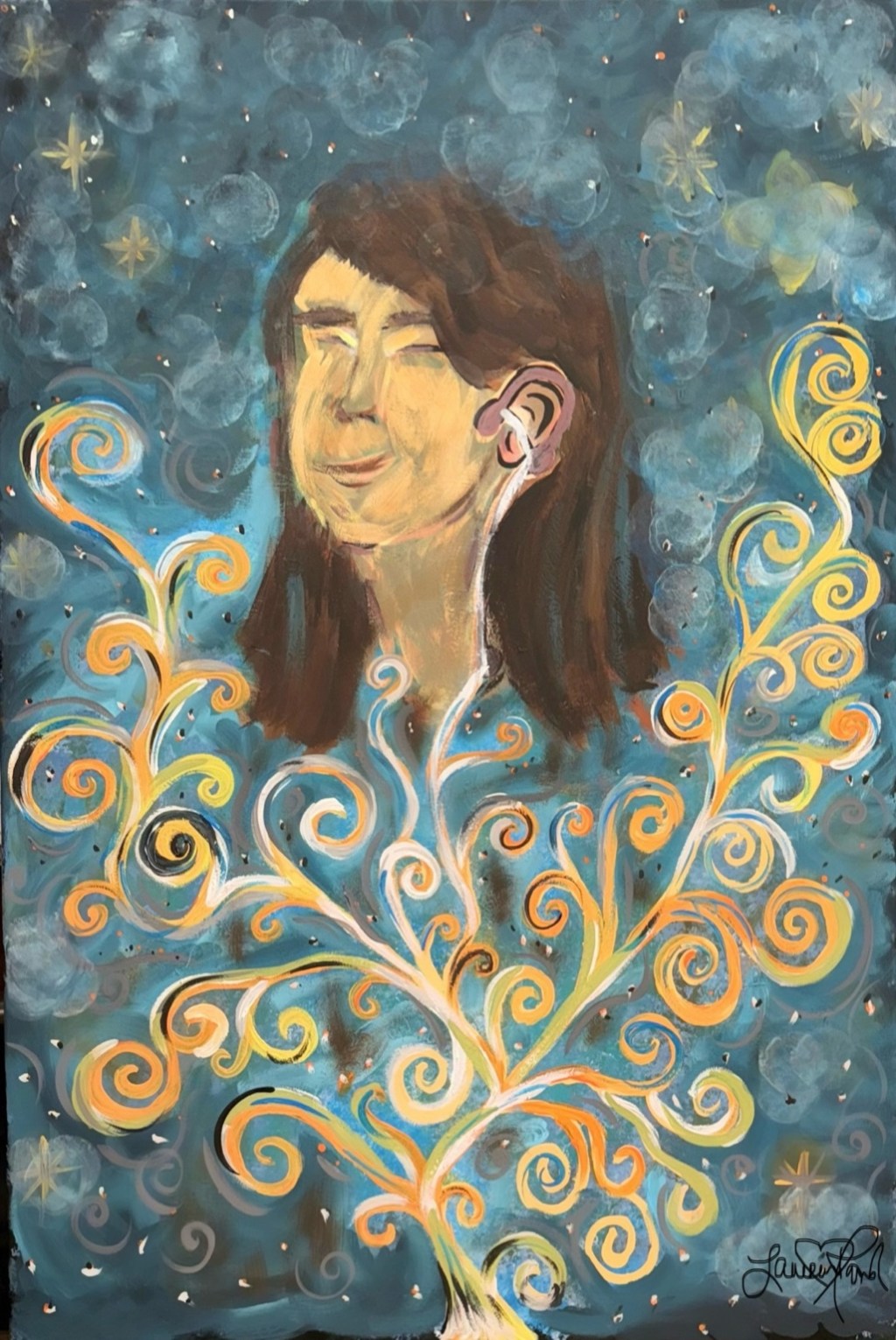
    I submitted one painting- in which I titled May She Have Peace (the main photo you’ll see on my last post) which is an attempt at a self portrait of myself mid-treatment. I’m currently a participant in a clinical trial for a group of researchers that are hoping to find the first FDA approved treatment for symptom management in patients like me.

    I’ve learned a lot about the vagus nerve and the autonomic nervous system. It’s interesting to see how much overlaps in patients with Ehlers – Danlos Syndrome. If you think a deep dive into all that I’m learning in my trial would be an interesting post, let me know in the comments below, I can definitely share my thoughts and experience as a patient in this study.

    The Rare Artist competition allows community members to submit more than one submission (two max) but only one can be finalist. I decided to submit my artwork and poem , but submit my artwork as a separate submission and an accompanying illustration for my poem. I think they fit together really nicely.

    I had to condense my poem down to 300 words or less, so I decided to submit an adapted excerpt. I think it still holds true to my original piece (but I still love the original more).

    Here’s the adapted excerpt. Let me know if you like the original or condensed version more!

    While I Wait for Relief by Lauren Hand (excerpt)

    While I wait for relief, I create.
    To give it a name.
    Doctors say:
    “Lose some weight.”
    “Wait! you’ve lost a lot… are you okay?”
    So I give them my tissue—
    to rule out every possible issue.
    So many tests.
    The nurse leans in:
    “Do you have someone to drive you home?
    You really shouldn’t have done this all
    alone.”
    As if I chose
    to give away 32 tubes just today.
    “Your labs look clear.
    Have you followed up with psych?
    Maybe give that a try.
    Pain like this is often… in the mind.”
    But the next day—
    ER – I’m in decline.
    Finally, someone believes what I’ve said.
    now that I’m here, in this hospital bed.
    While I wait for relief–
    There’s something new.
    “There are no guaranteesbut researchers are learning
    a lot about you.”
    While I wait for reliefI comply.
    I plug in.
    -deep breathEven if I don’t find healingthis’ll help the next.
    While I wait for relief, I show up.
    I speak.
    I create.
    I ache.
    Maybe I won’t be the one who’s saved,
    but the one who comes next, her path will
    be paved.
    May she live long and pain-free.
    …laugh without worry; breathe deeply and
    without fear.
    May she never ask,
    “Please, don’t make me laugh, dear.”
    May she never look at old photos
    and miss the flair
    she once had for life—
    before “flare” meant pain.
    Before “flare” became life.
    May she never worry if she’s believed.
    May she know peace.
    These are my prayers—
    While I wait for relief.

    thank you 🙏

  • While I Wait for Relief

    By Lauren Hand

    While I wait for relief—
    I create.
    Not to escape the pain,
    but to give it a name.

    Because if I can shape it,
    maybe someone else will finally see it. Understand it.

    Because if I can delight them-
    wow them-
    maybe I’m less of a burden.
    Maybe I can at least distract them
    from just how much I’m always in need of them.


    Doctors say:
    “Maybe it’s just your period.”
    “It’s probably anxiety.”
    “You’re too young for this—try taking better care of yourself.”
    “Lose some weight.”
    “Wait! Ms. Hand- you’re losing a lot of weight… are you okay?”
    “Before we check that, let’s rule everything else out first.”


    So I give them my tissue—
    to rule out every possible issue.
    Biopsies from my stomach.
    My colon.
    My esophagus.
    My small intestine.

    “Hey,” I say. “I’ve got an idea.
    While you’re in there,
    why not grab a few more pieces of me?”
    Because… why not?
    What’s one more?
    Or four?

    Seventeen.
    Seventeen samples.


    As if I chose
    to give thirty-two tubes away today.
    But sure—
    I’ll be back tomorrow.
    Same chair. Same needles.
    Same pain.


    “Ms. Hand, your doctor’s double-booked—
    you’ll see someone else instead.”

    “Hi. Name’s Dr. Hassan. Nice to meet you,”
    he says, without lifting his head.

    “Your labs look clear.
    Have you followed up with psych?
    I see you’ve seen her once before—
    maybe give that another try.
    Pain like this is often… in the mind.”


    But the very next day—
    I’m admitted. ER.
    And it’s septic.
    My system’s in decline.
    The irony burns—
    finally someone believes what I’ve said,
    but only now—
    now that I’m crying alone on this hospital bed.


    Tell me—
    How can you still not see me
    when you’re holding so many pieces of me?
    You have so much of me—
    in your lab.
    How can you be studying
    the inside of my body
    and still tell me
    it’s all in my head?


    New symptoms, new pain—
    “Guess what? Ms. Hand, You’re allergic to the new medicine again.”


    While I wait for relief
    I learn they’re offering something new.
    Though, through the FDA-
    it’s not yet approved.

    It’s a clinical trial.
    There are no guarantees-
    but researchers are learning
    a lot about people like me.

    This could open a world of new info,
    a world of new data.
    We still don’t know so much.

    Sign me up.!” No questions asked.
    And I feel a rush.


    “How long until it’s available?”
    “We don’t know.”
    “It may not leave the trial stage.”
    “It may never be developed
    beyond the prototype in your hands.”


    While I wait for relief—
    I comply.
    I plug in.
    A device on my ear,
    a quiet prayer in my chest,
    that even if I don’t find healing—
    this path might help the rest.

    Because maybe I won’t be the one who’s saved,
    but for them, the path will be paved.


    While I wait for relief—
    I give them so much of me,
    I become the proof
    that we are not invisible.


    While I wait for relief,
    I learn-
    life doesn’t get easier after diagnosis.

    But while I wait for relief—
    I show up.
    I speak.
    I create.
    I ache.

    I build the path
    for the one who comes next.


    May she live long.
    Pain-free.
    May she laugh without worry.
    May she breathe deeply—
    without discomfort, without fear.
    May she never have to ask her brother,
    “Please, don’t make me laugh, dear.”

    May she never fear her food.
    May she never fear her body.
    May she never wonder
    if her symptoms are too graphic to share.
    May she twirl around with the Florida sun in her hair.-
    Not worried about her stability or inability to stay upright.
    May she live with joy; live with out fright.

    May she never look at old photos
    and miss the flare
    she once had for life—
    before “flare” meant pain.
    Before “flare” became life.

    May she never worry
    that she won’t be believed.
    May she breathe freely.
    May she know peace.


    These are my prayers—
    while I wait for relief.